Split gear for roller kilns and dryers: cut replacement time from hours to minutes
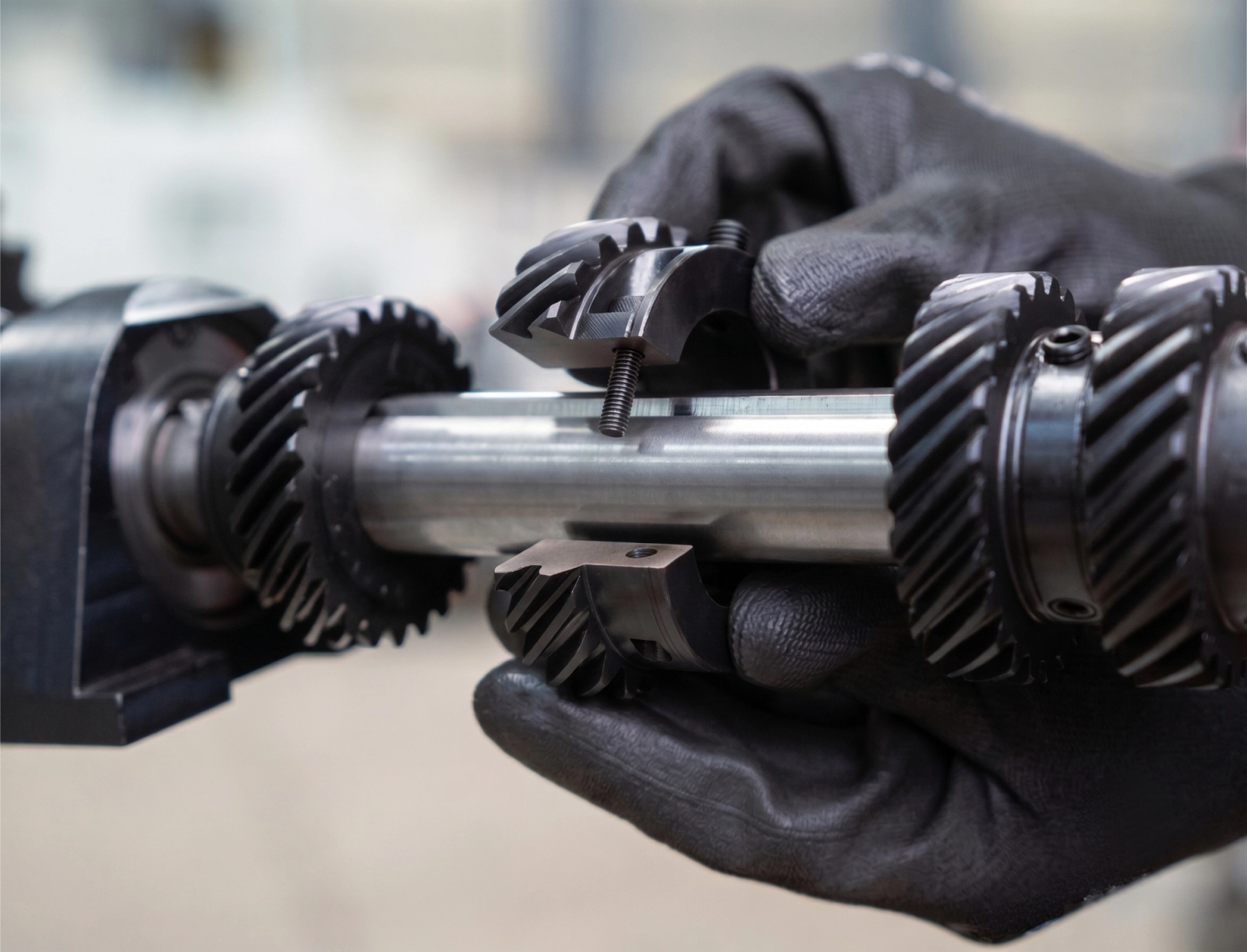
On a ceramic tile line, the cost of a maintenance stop is not measured only in furnace hours, it is also measured in the square meters that were never produced. In the maintenance of a ceramic roller kiln, few points in the drive weigh as heavily on that cost as the gear. In the one-piece version, the line is commonly down for around 6 hours to replace a single gear. In the split version, the same replacement takes about 15 minutes. The difference is not in what the gear does, but in how it is mounted on and removed from the shaft.
Why does a one-piece gear cost hours?
The gear is the transmission element that keeps the rollers turning inside the kiln or the dryer. When it is one-piece, that is, a closed ring, there is no way to install or remove the part without going over the end of the shaft. Replacing a gear therefore becomes a chain disassembly.
You have to release and remove the bearings, pull the shaft out of the assembly, take the worn gear off the end, fit the new one and retrace the whole path back, realigning and readjusting. Each step is teamwork, often with lifting equipment, and each one adds time. On a furnace that is still hot, you also wait for safe conditions to work. That is why six hours stops being the exception and becomes the rule, and the replacement starts to demand a full-shift stop instead of a quick window. Multiply your output per hour by the downtime and you see the real cost of a single replacement.
The split gear: the same gear with a different assembly architecture
The split gear keeps the same working geometry as the one-piece gear, same teeth, module, pitch diameter and transmission conditions, but it is made in two halves joined by fastening bolts. Each half is machined with precise seats and contact faces, so that once assembled the two parts work as a single meshing ring.
Because the gear "opens", it can be assembled directly around the shaft, in place, without pulling the shaft and without dismantling the bearings. The procedure changes completely: you release the worn gear, position the two halves of the new one around the shaft, tighten to the specified torque, check the alignment and the line runs again. The replacement that used to take a shift now fits into a short maintenance window.
What changes when 6 hours become 15 minutes?
The difference is around 96% in downtime, which makes the replacement close to 24 times faster. But the real gain goes beyond the clock. A 15-minute replacement fits into a routine stop, the kind the line already makes every day. A 6-hour replacement forces you to schedule a full-shift intervention, in advance, with a dedicated team and lost production in between.
It is the difference between handling the gear in a planned window and watching it become an emergency that brings the line down at the worst possible moment. In continuous production, that predictability tends to weigh as much as the time saved.
What separates a well-made split gear from an improvised one?
Splitting the gear is not cutting the part in half and bolting it. Two points decide whether it will last or become a problem.
The first is hardening. The gear teeth need heat treatment to withstand the wear of constant contact. Many manufacturers deliver the split version without hardening, and it wears out far sooner than it should. In practice, that trades the advantage of a fast stop for a short service life. A split gear for this kind of drive only makes sense hardened, with the same surface hardness expected from a quality one-piece gear.
The second is the fit of the halves. The split faces and the seating must be machined with precision so that, once bolted, the two halves form a continuous gear again, with no step and no gap at the joint. When that fit fails, the split becomes the weak point of the part and shows up as noise, vibration and uneven tooth wear. Well machined and well fitted, the joint compromises nothing, and the split gear works exactly like a one-piece one.
How to know if the split gear fits your equipment?
The replacement is straightforward as long as the new gear reproduces the geometry of the current one: module, number of teeth, diameter and the fit on the shaft. With this data, or with the code of the original part, we carry out the manufacturing analysis of the split version equivalent to the one you already use, including gears that today exist only in the one-piece form. The reasoning is the same for kilns and for dryers, because what defines compatibility is the geometry of the part, not the brand of the equipment.
At PACE, we manufacture hardened, made-to-measure split gears, equivalent to the factory parts, for ceramic kilns and dryers. With the code of the original part or the measurements at hand, we confirm the equivalence and the feasibility of the split version for your line.
Parts mentioned in this content
Frequently asked questions
Is the split gear as strong as the one-piece gear?
When there is quality hardening and precise machining, yes. It performs the same as a one-piece gear. Any fragility in the split gear comes from parts without hardening or poorly fitted, not from the split itself.
Can I replace a one-piece gear with a split one on equipment I already have?
Yes. After technical analysis, as long as the split gear reproduces the module, number of teeth, diameter and the fit on the shaft, it takes the place of the one-piece gear without touching the rest of the drive.
Does the split gear fit any kiln or dryer?
It fits any equipment whose gear is mounted on a shaft. Compatibility is defined by the geometry of the part, not by the brand of the kiln or the dryer. That is why manufacturing always starts from the measurements or the code of the gear you already use.